(Excerpts from keynote address delivered at the 1st International Conference on Ikeda/Soka Studies in Education, August 11, 2018, DePaul University, Chicago, Illinois)
Suppose there is a bitter persimmon. By soaking it in a solution of lime or buck-wheat chaff, or by exposing it to sunlight, we can make the persimmon sweet. There are not two persimmons, one bitter and the other sweet – there is only the one. The bitter persimmon has not been sweetened by sugar; rather, the inherent bitterness of the persimmon has been drawn out and its inherent sweetness allowed to emerge. The catalyst, the intermediary that assisted the transformation, was the solution or the sunlight.
(Ikeda 2003: 7-8)
This analogy by the great sixth-century Chinese teacher, T’ien-t’ai, can be useful to consider the direction for research and practice in Soka studies in education. For example, by comparing the Soka movement led by the Japanese poet and educator Daisaku Ikeda (b. 1928), to the non-violent satyagraha movement guided by the Indian political leader Mahatma Gandhi (1869-1948), we arrive at certain features of Ikeda’s education (in the broader sense of the term).
This comparison can also make significant contributions to the present discourse and practice of the United Nations Educational Scientific and Cultural Organization (UNESCO) led initiative of Global Citizenship Education (GCED or GCE). In referring to the Soka movement I am referring not just to the movement by the Soka Gakkai International (SGI) lay Buddhist organization but also to the development of various institutions by Ikeda (as represented by colleagues at this conference from the Ikeda Center in Boston, the SGI-United Nations representatives, friends from the Soka Kindergartens, Schools, and Universities). As well as, the movement created through Ikeda’s many dialogues to promote peace, culture, and education with the aim to help foster capable and contributive citizens across various nation states.
The persimmon analogy is also useful to understand why many studies on the practice of Ikeda’s educational ideas emphasize the role of the educator as well as the institutional ethos as being essential to draw out the ability within students to become value-creators, individuals who are committed to sustaining and enhancing all forms of life as planetary citizens. Using the analogy of the persimmon, the teacher and the institution’s untaught curriculum or ethos are the catalyst that can nurture the future citizens of the twenty-first century.
This conference is a timely response to the surge in activities within Soka studies. In particular within the given context of narrow nationalism, border walls, and our widening alienation, there is an urgent need to bring together the discourse and practice that has been taking place across countries on the Soka progenitors, Tsunesaburo Makiguchi (1871-1944), Josei Toda (1900-1958), and Ikeda. Several research studies are interested to examine soka as a pedagogical, philosophical, and curricular approach. There is also the opportunity to address the paucity of research and discourse on the sociological impact of Soka, for instance, as a socio-political construct. For example, Fisker-Nielsen’s (2012) work done in the UK on Komeito and youth emphasizes the contradictions and paradoxes that arise when values such as peace engage with real world politics. Obelleiro’s (2012) work on value-creating cosmopolitan education in the US makes similar contributions to the political dimension of Soka, at the heart of which as he suggests, is a sense of community building.
My recent book (Sharma 2018) launched in the UK at an event jointly hosted by the Center for Applied Buddhism and UCL-Institute of Education, London also engages with the political dimension of Soka with relevance to the field of global citizenship education. The book is a result of my long-term work done in Japan, Hawaii, India, UK, and the US. It examines the lessons that can be learned from examining soka as both a concept, as well as Soka as a community and as a movement. I must add here that it has been a challenge to conceptualize the socio-political-educational movement developed by Ikeda and the Soka progenitors. As Ikeda himself has remarked while describing Soka as a movement: “When confronted by something new, people generally try to get a handle on it and classify it by applying their old, conventional “maps”… thereby seeking to reduce it to the familiar and restore a sense of security. If they cannot adapt the new thing to the framework of their knowledge, they will often abandon it completely” (Ikeda 2008: 85).
So, who is this book for? While this book speaks to those who might be interested in both Soka studies and global citizenship education, the discussions are primarily aimed to contribute to the emerging discourse within global citizenship education through the non-Western examples of Makiguchi, Gandhi, and Ikeda. It is with the hope to draw the reader to engage in the two contributions that this book attempts to make through a study of these thinkers. Bringing Gandhi into our conversations is particularly relevant to both these aspects.
- First, their perspectives although situated in non-Western historical contexts are also rooted in an existential dialogue with the West. A historical and comparative study of their ideas can make important contributions to the existing discourse in global citizenship education.
- The second is that the examples of movements that motivate people to take positive action within their respective societies are embedded with learning that can inform classroom practice in global citizenship education.
I will not go into details of this work in this presentation but aim to highlight here some of the book’s arguments and contributions. To provide some context, within UNESCO’s Sustainable Development Goals (SDGs), Global Citizenship Education (GCE) is one of the strategic areas of its education sector program for the period 2014-2021. UNESCO’s work in this field is guided by the Education 2030 Agenda and Framework for Action, notably target 4.7 of the SDGs, which calls on countries to ensure that all learners are provided with the knowledge and skills to promote sustainable development, including, among others, through education for sustainable development and sustainable lifestyles, human rights, gender equality, promotion of a culture of peace and non-violence, global citizenship and appreciation of cultural diversity and of culture’s contribution to sustainable development (UN 2015).
This UNESCO initiative has developed parallel to Soka studies. Some scholars have been interested to examine the relevance of Ikeda’s work to the discourse on global citizenship education. Such as, analyzing Ikeda’s support (as a citizen) to the United Nations and his aim to foster global citizens as the founder of Soka education institutions. Interestingly, both fields have similar challenges along with their desired contributions. For example, attempts are being made to bring some order to the disarray in understanding key concepts, thoughts, themes, and perspectives. There is also a perceived gap between research and praxis in both fields (largely through research studies mapping out practice within schools). And the shared noble intent for those engaged in both fields is to nurture human beings who, whilst being rooted in their local communities are concerned with global issues that confront humanity. There is also the common ambition to develop capacity within students who can contribute to the global economy. The overarching attempt within global citizenship education and Soka studies is largely to promote global consciousness through an education that also meets national standards of competencies.
This book has two parts. The first engages with the theory and research. One of the contributions that my book attempts to make is to share key outcomes from my long-term and more recent work on value-creating global citizenship education. It examines the relevance of Ikeda’s Soka or value-creating education to contemporary education, human rights, and a sustainable future (Ikeda 2003, 2008, 2014, 2018; Sharma 2008, 2018). Value-creating global citizenship education expands the current focus within education on individual empowerment and collaboration, to enhance the possibilities for a creative coexistence (see Goulah 2010).
This study proposes a shift in emphasis within the three domains of learning as currently described for the practice of global citizenship education by UNESCO (2015), from critical thinking within the cognitive domain to dialogue and dialogic modes of learning, from empathy and consideration of others within the socio-emotional domain to friendship and compassion, and from charity and advocacy within the behavioral dimension to enhancing value creation for self and others.
Through my study of selected Asian thinkers and their respective movements, there are two questions that can allow a re-examination of the practice of the SDGs – within our individual lives, communities and organizations we work with or are a part of, and most importantly in our endeavor to engage youth in achieving these goals. These are,
- Are there different ways in which we might approach issues of social justice? And tied to this question is
- How can we expand our focus from individual empowerment to enable bold collective efforts?
It is no exaggeration to state that given the heavy dominance of neoliberal capitalism worldwide and its impact across various national educational policies, the efforts and plans to tackle the SDGs (and this can be said for education in general), are largely oriented to empower the individual human being. While this is important, it also leaves out the particularities that are also equally important in meeting these goals, such as, the particularities of culture, of the individual’s needs, interests, and values.
One of the guiding questions for my work has been on how education can focus on the individual but not become trapped in promoting individualism. This to me is a serious concern that has emerged from the Enlightenment period, Western-scientific-industrial revolution, and modern capitalism. My study of selected Asian thinkers suggests that there are examples of Hindus (such as Gandhi) and Buddhists (such as Ikeda) who have developed creative change within their respective communities based on their values and beliefs.
What education for global citizenship is lacking in many ways is to engage with the values of the learner so as to enable them to develop their own identities in a positive way. Here especially relevant is a recent study by Dill (2013) on selected religious and public schools that engage with particularities in global citizenship education instead of flattening out differences. An example given is that of Muslim young women respondents who as Dill describes state that, “the particulars of their religious faith serve as a source for their commitment to more universal themes of global citizenship” (Dill 2013: 131). This is similar to Gandhi. As mentioned in my previous study, “as Gandhi claimed, being a ‘good’ Hindu did not lead him to the Himalayas, but forced him to contend with the issues within the Indian society and politics” (Sharma 2008: 129). My long-term study of thinkers like Gandhi, Ikeda, and Ikeda’s predecessor Makiguchi shows that their engagement with particularities, values, and beliefs have led to their own creative and distinct strategies and action to create positive change and sustainable communities within their respective geographical locales. Of course, values and beliefs are not something that comes only from our faith, but importantly they are developed within our daily lives at home and in communities in which we live.
The second part of this book makes suggestions for the practice of education for global citizenship through a more creative engagement with and an understanding that there are a variety of ways of thinking, acting, being, and living that inform people and communities and that there are important lessons that can be drawn from the vast repository of human wisdom.
One of the praxis chapters offers themes for the practice of value-creating global citizenship education. Within each theme a brief description is provided that challenges epistemic assumptions for the practice of global citizenship education that is currently often based on a neoliberal paradigm. I offer here suggestions for practice based on a study of Asian examples and movements. Overall these themes are designed to support the learner’s happiness, well-being, and the development of the capacity to create value.
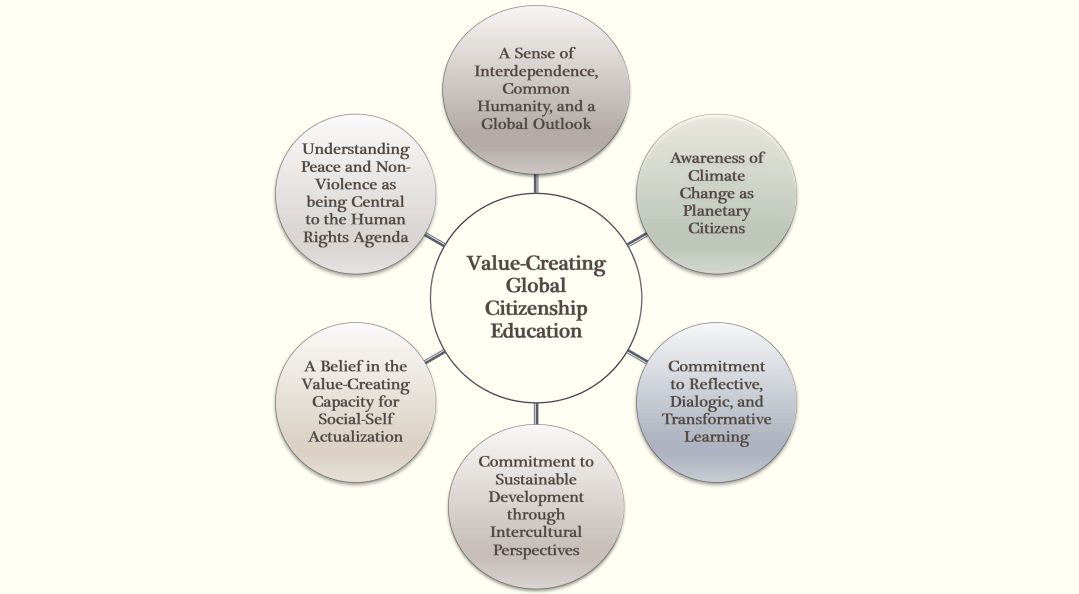
Fig. Framework for value-creating global citizenship education (Sharma 2018: 94)
The proposed framework covers six themes within the practice of value-creating global citizenship education that aim to promote the necessary knowledge, skills, values, and attitudes to enable learners to develop:
- A sense of interdependence, common humanity, and a global outlook: that explores existential questions including that from non-Western perspectives; while also challenging colonial perspectives.
- An awareness of climate change as planetary citizens: that acknowledges that climate change is real; develops a wonder and appreciation for life as creative coexistence; and mandates an urgent action and concern for the welfare of the planet by the citizens of the earth.
- A commitment to reflective, dialogic, and transformative learning: the main outcome from an engagement with issues on social justice should be to foster learners as agents of social transformation but with the dual goal of how that transformation has developed their own lives in terms of tapping into their inner resources such as wisdom, courage, and compassion.
- A commitment to sustainable development through intercultural perspectives: that engages with particularities and specificities of the local while also connecting with global issues; and the integration of lessons from history on the normative and creative use of values across societies such that a study of dissidents like Gandhi and his movements can promote. As well as the more recent impact of social media across different regions and lives, for example, #ClimateCrises activists, #strikeforclimatechange, #blacklivesmatter, and #MeToo movement.
- A belief in the value-creating capacity for social and self-actualization: that can approach issues concerned with social justice, gender, and equity through developing the value-creating capacity of the learner to contribute to individual benefit and social good.
- An understanding of peace and non-violence as being central to the human rights agenda: that builds character through a critical engagement with studies on the patterns of living of people and communities across Western/non-Western diasporas that are based on peace and non-violence.
Overall, based on my study of Asian perspectives an acknowledgement of one’s common humanity I have argued, would give emphasis to perceiving the divisiveness and alienation that is present within modern societies. That is, it would place a strong emphasis within the curriculum to tackle stereotyping and foster the socio-emotional capacity of compassion towards all inhabitants of the earth whilst also recognizing the nature and forms of power structures in an increasingly globalized world and the unseen perpetuation of colonial perspectives. The behavioral response to solve global issues would be rooted in a non-dualistic belief system that through an intuitive examination of the depth of human life subscribes to the view that an attitudinal change within each person can impact upon their environment (see Ikeda 2003: 106). The educational environment will be developed to foster meaningful life-to-life connections among people – between students and teachers, schools and communities, and so on. This book is not only for educators, but for all who are engaged with fostering youth, the citizens of this world.
I would like to end my talk today with one of the key suggestions made in my recent book that could help develop Soka studies globally as a valid and recognized field of educational study. And that is, the necessity of a historical and comparative study that examines Ikeda as a historical actor, his creativity as analyzed by contextualizing his contributions from within his historical locale, as well as his influence within different communities and countries, within the particularities of selected schools and on youth and education. Comparative research here includes the influence of particularities, the factors that determine how Soka studies or the practice of it gets shaped within a selected institution, or within a specific context. For example, by people and networks formed across local and regional locales and their influence in shaping research and praxis across particularities. A two-pronged approach to advancing the field of Soka studies will therefore require some sort of consensus on perspectives that (a) reflect the original intent of the thinker and are universal, and (b) also recognizes that practices, and possibilities are shaped by particularities.
Thank you so much for your time and attention!
References
Dill, J.S. (2013). The longings and limits of global citizenship education: The modern pedagogy of schooling in a cosmopolitan age. New York: Routledge.
Fisker-Nielsen, A. M. (2012). Religion and politics in contemporary Japan: Soka Gakkai youth and Komeito. Japan Anthropology Workshop Series. London: Routledge.
Goulah, J. (2010). From (harmonious) community life to (creative) coexistence. Considering Daisaku Ikeda’s educational philosophy in the Parker, Dewey, Makiguchi and Ikeda “reunion.” Schools: Studies in Education, 7(2), 253-275.
Ikeda, D. (2003). Unlocking the mysteries of birth and death…and everything in between: A Buddhist View of Life (2nd ed.). Santa Monica: Middleway Press.
Ikeda. D. (2008). My dear friends in America: Collected U.S. Addresses 1990-1996 (2nd ed.). Santa Monica: World Tribune Press.
Ikeda, D. (2014). Value creation for global change: Building resilient and sustainable societies. 2014 peace proposal. Soka Gakkai. https://www.daisakuikeda.org/main/peacebuild/peace-proposals/pp2014.html
Ikeda, D. (2018). Toward an era of human rights: Building a people’s movement. 2018 peace proposal. Soka Gakkai. https://www.daisakuikeda.org/main/peacebuild/peace-proposals/pp2018.html
Obelleiro, G. A. (2014). Cosmopolitan education and the creation of value [Unpublished doctoral dissertation]. Columbia University.
Sharma, N. (2008). Makiguchi and Gandhi: Their educational relevance for the 21st century. Lanham: University Press of America, Rowman & Littlefield.
Sharma, N. (2018). Value-creating global citizenship education: Engaging Gandhi, Makiguchi, and Ikeda as examples. Cham: Palgrave Macmillan.
UN. (2015). 2030 agenda for sustainable development and its 17 sustainable development goals. http://www.un.org/sustainabledevelopment
UNESCO. (2015). Global citizenship education: Topics and learning objectives. Paris: UNESCO.